
Written April 2023, Updated September 2026
PART TWO
Things in the colony took a turn after Bacon’s Rebellion. This was largely due to who exactly had rebelled. Bacon had been successful in recruiting not only poor and middle-class English colonists, but also Africans and people of African descent.
The House of Burgesses realized that Bacon’s followers had put aside perceived differences to fight towards a common goal. Thus, the Burgesses felt it was in their own best interest to divide and conquer the poor of Virginia. After Bacon’s Rebellion, the legislature began enacting laws known as the Black Codes, restricting the rights of Africans and their descendants within Virginia. In 1680 a law was passed prohibiting Blacks from owning firearms, congregating in large numbers, and attempting to escape. Soon other colonies were enacting similar laws.
The laws became more and more restrictive until people of African descent were forbidden basic rights like freedom of marriage, self-defense, education, and participation in government. Most importantly, the Black Codes set up a legal framework for hereditary chattel slavery. This describes a condition in which a person is bound to uncompensated servitude for their entire life based upon the status of their mother. The Black Codes further enshrined enslavers’ rights to abuse, assault, buy, sell, and even kill enslaved people. This all was influenced by Bacon’s Rebellion and reflected wealthy colonists’ fears of a second uprising. It set in motion the race-based, hereditary lifetime slavery that would exist in America until 1863. We still see fallout from Bacon’s Rebellion today in the form of racism, discrimination, and inequity.
The Rebellion was extremely damaging to Indigenous people as well. Indigenous groups including the Doeg, Occoneechee, Nottoway, Pamunkey, Nansemond, and Weyanoke had been the main target of Nathaniel Bacon’s rage, and much of the violence had been aimed at them. Many of the tribes Bacon’s men assaulted had established treaties with the English, some of them decades-old. Leaders of these groups felt that Berkeley had failed them as an ally.
In 1677, the Treaty of Middle Plantation was signed. Middle Plantation covered a large area, most of which we would now call Williamsburg. Tribes who lived in the vicinity, including the Pamunkey, the Nottoway, the Weyanoke, and the Nansemond, signed this treaty with King Charles II of England. It established an agreement, through which the tribes named in the treaty were given clearly defined boundaries, which the English agreed to respect. However, it restricted Indigenous people’s freedom of movement, and required them to effectively rent their own land from the English king. The tribes agreed to provide tribute to the Governor of Virginia, and align themselves with the government in case of a similar uprising. The Treaty of Middle Plantation is still invoked today to establish or defend tribal boundaries and land use rights.
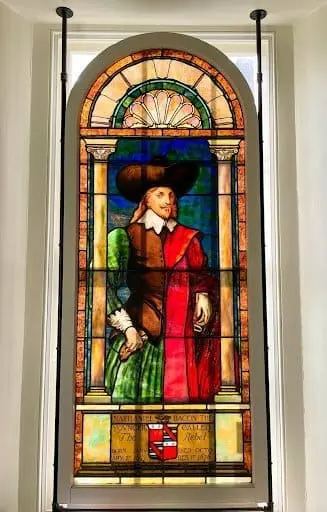
126 years after Bacon’s Rebellion, in 1803, an account of the event fell into the hands of Thomas Jefferson. Jefferson was then president, but still found time to read the manuscript, written by Thomas Mathews in 1701. Mathews’ retelling of Bacon’s Rebellion was fanciful and rather biased, but Jefferson quickly saw himself in this version of Nathaniel Bacon. Here, he thought, was a Virginian who stood up to colonial government exactly 100 years before Jefferson had penned the Declaration of Independence! To Jefferson, this showed Virginia had always been ahead of the curve, reinforcing his sectionalist ideas of Southern supremacy. Bacon’s desire to exterminate Indigenous people was not a problem for Jefferson, who was himself deeply prejudiced against tribal communities.
In order to “rescue” the reputation of Nathaniel Bacon, Jefferson commissioned a comprehensive history of Virginia. He selected a fiery young Irish playwright named John Daly Burk, who had been targeted by the Alien and Sedition Acts. Jefferson offered Burk refuge in Virginia. Although Burk was known at the time for colorful yet inaccurate portrayals of historic events, his loyalty to Jefferson guaranteed the book would be to Jefferson’s liking. Relying on source material supplied by Jefferson and his allies, Burk wrote A History of Virginia, published in 1804 and 1805.
Burk’s History of Virginia was deeply biased, racist, and contained a great deal of conjecture. It painted Nathaniel Bacon as a gentleman and a scholar, a true man of the people. Nevertheless, Burk’s account was the most widely used history of Virginia for forty years. Even when other authors began writing newer histories, they universally relied on Burk’s book instead of analyzing primary sources. During the 19th century, as a result, Nathaniel Bacon became deified in the American imagination, despite the disturbing reality of his legacy.
But how did Bacon lend his name to a “castle” he never even visited? The answer is still unclear. An 1802 will references the plantation as Bacon’s Castle but makes no mention of property boundaries, indicating the scope of Bacon’s Castle plantation was well known. Did former rebels come up with the name in the 17th century? Or was it the result of some descendant who only knew a partial account of events? Whatever the case, by 1809 the entire neighborhood was known as Bacon’s Castle, sporting its own post office until the 20th century.
In 1974, Preservation Virginia acquired Bacon’s Castle and began to gain a clearer understanding of the site. Through meticulous research, scholars overturned centuries of myths about Nathaniel Bacon’s involvement with the property. The name, however, remains. Today, Bacon’s Castle is a museum dedicated to telling the full story of Bacon’s Rebellion, in all its complexity.
Sources:
- Tarter, Brent,. “Bacon’s Rebellion, the Grievances of the People, and the Political Culture of Seventeenth-Century Virginia.” The Virginia Magazine of History and Biography, vol. 119, no. 1, 2011, pp. 2–41. JSTOR, http://www.jstor.org/stable/41059478. Accessed 8 Feb. 2023.
- Rice, James D. “Bacon’s Rebellion in Indian Country.” The Journal of American History, vol. 101, no. 3, 2014, pp. 726–50. JSTOR, http://www.jstor.org/stable/44286295. Accessed 8 Feb. 2023.
- “Persons Who Suffered by Bacon’s Rebellion. The Commissioners’ Report.” The Virginia Magazine of History and Biography, vol. 5, no. 1, 1897, pp. 64–70. JSTOR, http://www.jstor.org/stable/4242017. Accessed 8 Feb. 2023.
- Race: the Power of an Illusion: Interview with Ira Berlin. https://www.pbs.org/race/000_About/002_04-background-02-08.htm
- https://www.thirteen.org/wnet/slavery/timeline/1694.html
- The Articles of Peace. 1677. https://encyclopediavirginia.org/entries/articles-of-peace-1677/
- Edwards-Ingram, Ywone. Africans and African-Americans at Bacon’s Castle, Surry County, Virginia: A Report for the APVA. Colonial Williamsburg Foundation, 2007.