
Virginia’s Most Endangered Historic Places List 2026
Each May — National Historic Preservation Month — Preservation Virginia publishes a list of historic places across the Commonwealth facing imminent or sustained threats. The list, which has raised awareness for over 200 sites in Virginia, encourages individuals, organizations and local governments to advocate for their preservation and find solutions that will save these unique locations. The program has a proven track record of success, only 10% of the sites listed since the program began have been lost to demolition or neglect.
This year’s list of Virginia’s Most Endangered Historic Places reflects the increasing pressure of new development on historic communities and the ongoing impacts of the data center industry. During the 250th anniversary of the founding of the United States, it’s critical to find ways to grow thoughtfully while preserving the places that share the American story.
In no particular order, Virginia’s Most Endangered Historic Places for 2026 are:


Old Bennett School Complex – City of Manassas
Constructed in 1909, Old Bennett was the first school built in response to a statewide education funding initiative. During construction, burials of Civil War soldiers were discovered on the site. Now part of the Prince William County Judicial Campus, plans for new facilities indicate the school will be demolished. Incorporating Old Bennett School into the updated judicial campus is critical to saving this important cultural resource in Old Town Manassas.
For more information: Colin Turner, clntrnr@gmail.com

Wiehle Town Hall – Reston
Listed on the National Register of Historic Places, this building was originally the centerpiece of German immigrant and businessman C.A. Max Wiehle’s “utopian community.” His idea of a self-sufficient community faded with his death in 1901, and eventually the A. Smith Bowman Distillery used the building for its operations. Last year, it was listed for sale. Significant development pressures in this region of Virginia make the future of this building uncertain.
For more information: Ken Plum, kenplum@aol.com

Historic Cave Spring Community – City of Roanoke
The village of Cave Spring was a thriving crossroads community from the mid-19th to the mid-20th centuries in southwest Roanoke County. Cave Spring had humble beginnings as a resting spot due to the spring, attracting Native Americans and later farmers going to market in Big Lick (Roanoke City). Its broader community faces increasing development pressures, and balancing thoughtful growth and preservation are needed to save this cultural resource.
For more information: Alison Blanton, ablanton@hillstudio.com

Queen Miller Home – City of Staunton
Queen and William Miller committed their personal assets to the care of more than 300 African American children in need of education and community in the early 1900s. The original home on the site burned in the 1950s, and the property currently faces a tax sale. A possible preservation strategy is to secure the property to use it as a heritage park commemorating the commitment of the Millers and the education of Black children in the Staunton region.
For more information: Moonyene Jackson, millerjackson.historicpres@gmail.com

Powhatan’s Birthplace – Henrico County
Threatened by a 2,700-home development, this location at the fall line of the James River is the site of Chief Wahundsenacawh’s (Powhatan’s) birthplace. Under his leadership, the Powhatan Confederacy was one of the largest native alliances in the Mid-Atlantic region, and his resistance to English colonization is still impactful today. Six Virginia Indian Tribes have united to save the site, which should be accessible to the Tribes “as a place of power, remembrance, and ceremony.”
For more information: Ashley Spivey, aaspivey@kenah.com

Downtown Historic District – City of Harrisonburg
Balancing the need for additional housing with the preservation of historic districts is an increasingly pressing issue in Virginia. Over the last decade, at least ten contributing structures were demolished in the Harrisonburg Downtown Historic District, a district with less than 150 buildings. A new development of 250 apartment units further threatens the district. Rightsizing infill development and encouraging the adaptive reuse of existing structures will help preserve downtown while allowing for new housing.
For more information: Phillip Herrington, philip.m.herrington@gmail.com

Wertland Street Historic District – City of Charlottesville
Last year, the historic Wertenbaker House near the University of Virginia was proposed for demolition to develop luxury student housing. The site had already been approved for infill development adjacent to the historic house of UVA’s librarian from 1826-1881. Though the local Board of Architectural Review and City Council denied the demolition permit, the house and the Wertland Street Historic District face significant development pressures and suffer neglect. The challenge is to identify and secure a buyer for the centerpiece Wertenbaker House while pursuing best infill development practices that combine preservation and new construction in a dense urban district.
For more information: Preservation Piedmont, preservationpiedmont@gmail.com

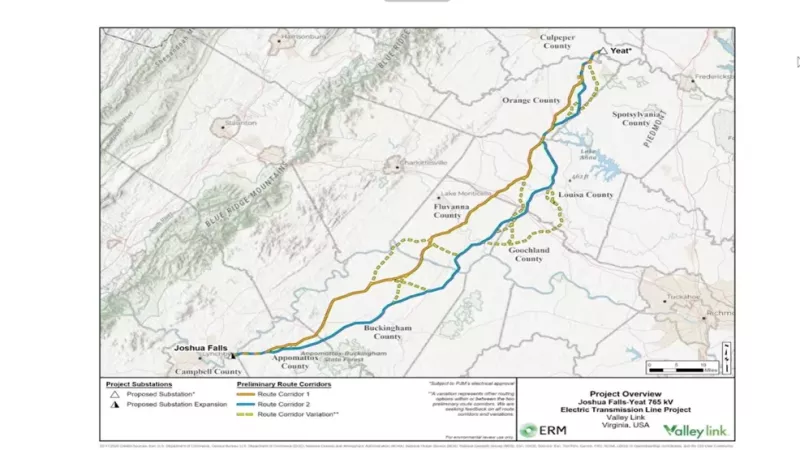
Joshua Falls-Yeat Transmission Line Corridor – Multiple Counties
Largely driven by the result of the exponential growth of the data center industry and the energy they require, this new transmission line would be the largest ever constructed by Dominion. 11 historic districts and several battlefields may be affected. The demand for additional land and electric power by data centers continues to impact conserved viewsheds and historic districts throughout Virginia. Solutions could include exploring alternate routes, using existing rights-of- way, or undergrounding the lines, but the overall project speaks to the continuing pressures created by the data center industry.
For more information: Don McCown, dmccown@pecva.org
Historic Westwood Neighborhood – City of Richmond
Despite numerous attempts at erasure, Westwood remains a diverse community of single-family homes owned by generations of African Americans. Founded by formerly-enslaved individuals after the Civil War, proposed changes to the local zoning code could have adverse effects on a community already under development pressure. Zoning changes that avoid displacing current residents and alleviating urban heat island effects are essential in this and other historically black neighborhoods in Richmond.
For more information: Rev. Jeannette Brown, Revjlb515@gmail.com

