
“From George Washington to Thomas Sim Lee, 15 September 1781
Head Quarters Williamsburg 15 Septr 1781
—
Sir I am now happy to be able to inform your Excellency, that the Count DeGrasse is returned to his former Station at Cape Henry, havg driven the British Fleet from the Coast—formed a Junction with the Squadron of the Count DeBarra’s, & captured two British frigates—the Bay being thus secure, I have given Orders for the Troops to proceed with all possible Dispatch to the point of Operation.”
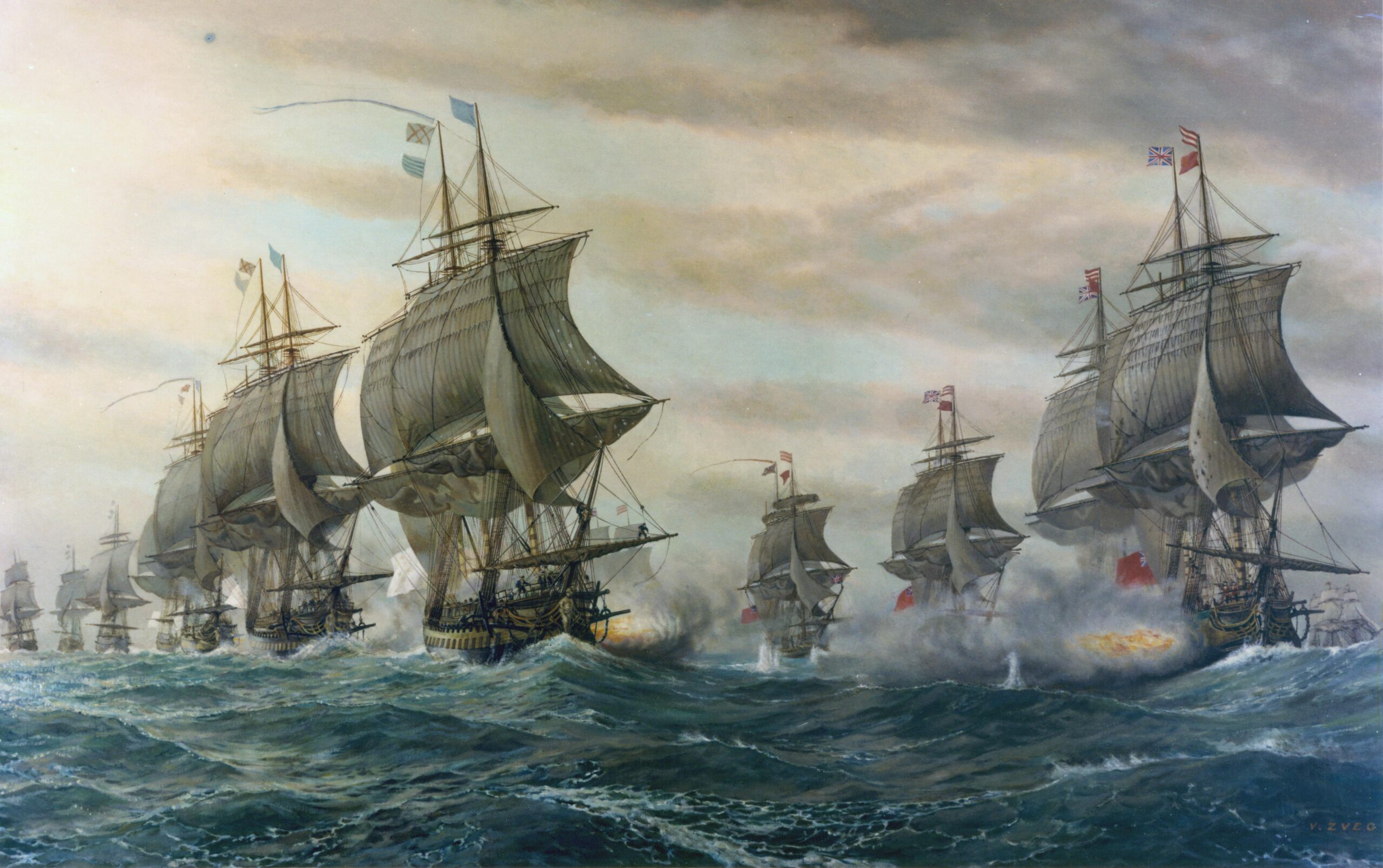
Before the British surrendered on land at Yorktown on October 19, 1781, a battle was fought on the water; this showdown off the coast of Yorktown set the stage for what’s arguably the most decisive victory of the American Revolutionary War. One ensuring American Independence.
More than a month before Yorktown victory, Washington sent a letter dated September 15, 1781 to Thomas Sim Lee, then-Governor of Maryland. Washington was headquartered in Williamsburg- preparing for the battle to come approximately 13 miles down the road, at Yorktown. An excerpt of this letter serves as the opening for this article.
Washington’s letter affirmed the successful efforts of Francois Joseph Paul, the Comte. DeGrasse, French Naval Commander. DeGrasse had sailed his fleet northward to Virginia through the Caribbean in support of the Continental Army. The request for his presence came from Washington and the Commander of all French forces in America, Jean-Baptiste Donatien de Vimeur, Comte. de Rochambeau.
DeGrasse had a decision to make: New York or Virginia.
Upon receiving word from Virginia that British General Lord Charles Cornwallis was fortifying the port of Yorktown– and that DeGrasse chose to sail to the nearby Chesapeake Bay instead of New York, Washington and Rochambeau headed south. This move to abandon the earlier plan of (hopefully) recapturing New York proved to be a critical decision, and was the one Rochambeau preferred.
Major General the Marquis de Lafayette, a French aristocrat who volunteered to serve in the Continental Army only a few years earlier, was already in Virginia. For most of 1781, he’d been playing what he described in a letter to General Nathaniel Greene as a “cat and mouse” campaign with the British. From Patrick Henry’s Scotchtown to the campus of William and Mary, Lafayette’s men had moved through the region, reaching Williamsburg in advance of Washington and Rochambeau’s forces.
After arriving at the Chesapeake Bay August 31, 1781, DeGrasse offloaded supplies and prepared to face the British Navy. On September 5, 1781, a battle lasting under three hours transpired. British Admiral Graves, who had only entered the Bay that morning after a voyage from New York (where he thought the French were planning to attack) was left with a decision to make after suffering heavy damage. After several days without engaging, he made his critical decision to retreat. Graves’ decision to head back to New York left General Cornwallis trapped at Yorktown.
By September 19th, word had been sent on to Washington in Williamsburg and he was able to share the news with Lee in Maryland, as well as request axes, hatchets, and flour for bread.
- The Battle of the Capes, alternatively referred to as The Battle of the Chesapeake, was over.
- The British were stranded in Yorktown, without access to reinforcements or supplies.
- And the Marquis de Lafayette had set up camp awaiting thousands of French and American troops headed to Williamsburg.
American victory was on the horizon.
The best way to experience this extraordinary history is to get close to it. Visit what was the first federally funded public works project: Cape Henry Lighthouse.
An historic site completed in 1792 while President Washington was at the helm of our new nation, it’s currently maintained by Preservation Virginia. Visiting offers you a literal view over the bay, where you can envision this critical achievement by DeGrasse and the French Navy.
The truth about history is this: it’s more than dates. There are pivotal moments, critical decisions, human interactions, responses, and motivations that lead from one event to the next. At Preservation Virginia, care is taken to incorporate multiple threads woven into the fabric of an historic site.
The Battle of the Capes is a pivotal “moment.” Being in a lighthouse, a 1792 structure, overlooking the waters DeGrasse’s fleet sailed– that is an intensely emotional opportunity.
Washington himself, as President, could surely count Cape Henry Lighthouse as an accomplishment under his tenure.
Cape Henry Lighthouse was built near the “First Landing” location of English Settlers headed to Jamestown in 1607. It’s an early American treasure, currently staffed by a team dedicated to sharing all of the history in and around the lighthouse itself.
[Note: Cape Henry Lighthouse sits inside Fort Story; please utilize the information on this website to plan your trip as entry processes are updated due to base requirements.]
Citations:
George Washington, “To Thomas Sim Lee,” Founders Online, National Archives, accessed July 21, 2026, https://founders.archives.gov/?q=%20Period%3A%22Revolutionary%20War%22%20Author%3A%22Washington%2C%20George%22%20Degrasse&s=1111311113&r=11.
National Park Service. “Battle of the Capes.” Yorktown Battlefield, Colonial National Historical Park. Last updated December 15, 2024. Accessed July 21, 2026. https://www.nps.gov/york/learn/historyculture/battle-of-the-capes.htm .
Lafayette, Marie Joseph Paul Yves Roch Gilbert du Motier, marquis de. To Nathanael Greene. Gilder Lehrman Institute of American History. Accessed July 22, 2026. https://www.gilderlehrman.org/collection/glc06323
About the author: Daphne Reznik is the creator of the What American History is About blog. Born in Chicago and living most of her life in Michigan, she moved to Virginia in 2021. After spending years in both state government and corporate life, she’s making her love of history the focus of her career. Daphne resides in Williamsburg, Virginia where she is a certified tour guide passionate about both learning and sharing the history of our nation. Daphne also creates curated travel itineraries for visitors to the region. Browse Daphne’s blog and tour offerings here: linktr.ee/DaphneFreeAt50